Michael Burry Sounds a Warning on Artificial Intelligence
Burry's big bearish bet on Nvidia and Palantir reminds us that not all AI is the same.
Author
G. Tempesta
Published
Reading
6 min
Updated
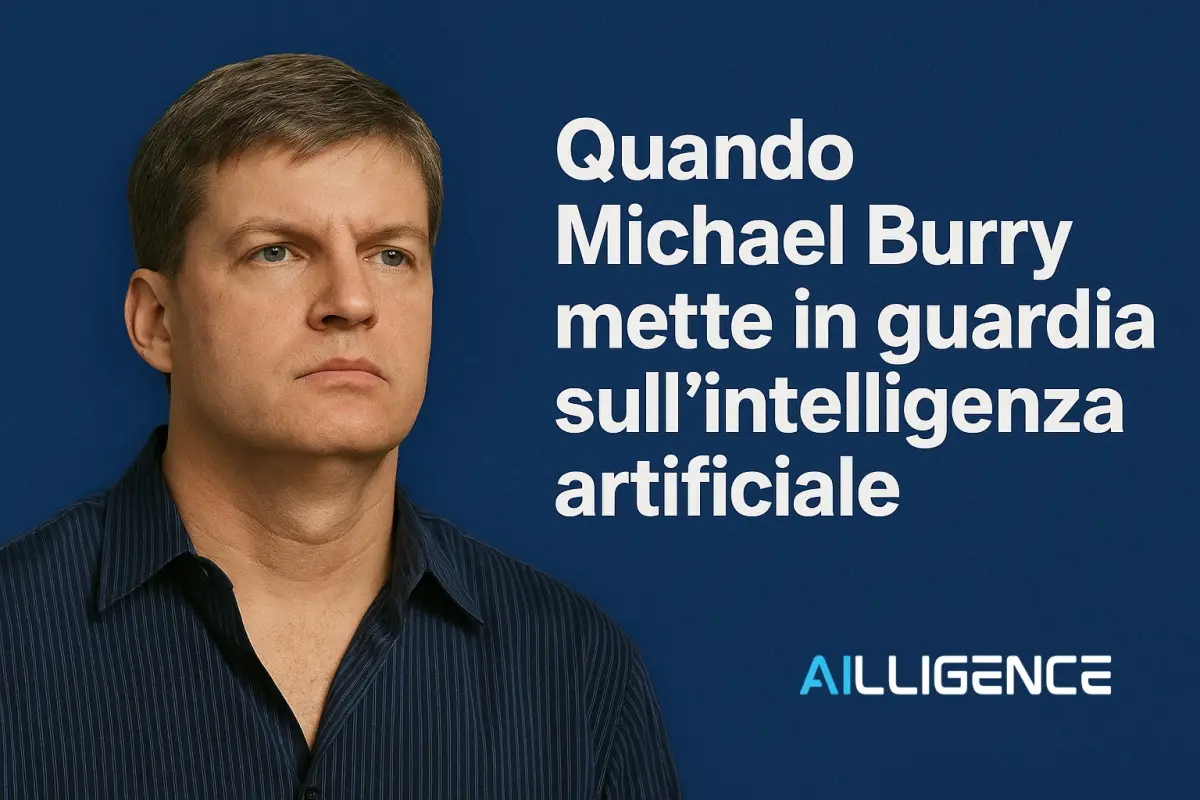
In recent months the well-known investor Michael Burry has once again caught the world’s attention. Not for a new prediction about property markets, but for a bold and provocative bet: he opened large bearish positions, through put options, on stocks that symbolise the artificial intelligence race, such as Nvidia and Palantir. This is not a millionaire’s whim but a powerful signal: according to Burry, the AI wave risks being inflated by questionable accounting, with overly long depreciation periods and artificially boosted profits.
In this article we look at what Burry did, why his reasoning matters even for those who do not invest in the stock market, and why a serious, measurable and sustainable way of bringing artificial intelligence into a business is needed, avoiding the hype and focusing on real value.
Burry’s move: a lesson for investors and entrepreneurs
Michael Burry is not just anyone. Having become famous for predicting the 2008 subprime mortgage crisis, he is now issuing a warning about AI. Through his firm Scion Asset Management he bought put options on Nvidia and Palantir, two companies that have become symbols of the AI era.
The figures are striking: according to analyses, Burry took a put position equivalent to one million Nvidia shares, with an estimated notional value in the hundreds of millions of dollars. On Palantir, his bearish investment is even larger: put options equivalent to millions of shares, for a notional value of almost one billion dollars. These numbers are not mere speculation: they reflect deep scepticism about the current narrative around artificial intelligence.
This is not just a financial bet. Burry has raised a real alarm about the business models of many tech companies: in his view, the accounting of many AI companies rests on unrealistic foundations.
Burry’s criticism: overly long depreciation and artificial profits
The core of Burry’s analysis concerns the way many large tech companies handle the costs of AI hardware. In particular, he challenges the use of excessively long depreciation cycles for GPUs, servers and data centre infrastructure.
According to Burry, many companies state that their GPUs last five or six years, when in practice their useful life may be much shorter, perhaps only two or three years. This artificially extends the accounting life of the components and spreads their cost over more periods. The result is balance sheets that look stronger, with inflated earnings per share and a distorted view of profitability.
For Burry, this accounting strategy is not a niche detail: it is one of the most common levers used to mislead the market. In a social media post he spoke of what he calls “one of the most common frauds of the modern era”: using optimistic depreciation to mask the economic reality of AI hardware. If his analysis is correct, this practice could lead to a cumulative overstatement of profits that, over the coming years, could reach hundreds of billions of dollars.
The withdrawal of Scion: a change of paradigm for Burry
But the story does not end with the put options. Michael Burry has also decided to deregister his management company, Scion Asset Management. This means he will no longer manage outside capital as a hedge fund, but may become a private family office focused on his own wealth.
This change is significant: it signals that Burry is no longer interested in raising external funds under traditional management models, but wants more direct control over his personal investments. Despite the formal withdrawal, he has said he remains active in the markets. For many observers it is a strategic move: keeping the freedom and flexibility to make unconventional bets without having to answer to institutional investors.
Why Burry’s lesson matters even if you do not invest
It may seem that this story only concerns the world of high-risk finance, but in reality it has deep implications for businesses, managers and entrepreneurs too.
AI is not just a buzzword
Burry’s move highlights that not every company using the word AI is creating real value. Many claim to be “AI-driven” simply to ride a trend, with no solid strategy behind it.
The risk of creative accounting
If even an experienced investor like Burry believes that many companies are relying on overly optimistic depreciation, it is reasonable for managers and entrepreneurs to ask themselves: are we really thinking long term? Or are we just presenting good-looking accounts?
The importance of tangible value
Rather than promises of explosive growth, businesses need to invest where AI can make a concrete difference: more efficient processes, better decisions, lower costs, a better customer experience.
Strategy versus hype
Burry’s example is an invitation not to follow the artificial intelligence trend blindly, but to develop a realistic and sustainable plan.
How Ailligence turns AI from hype into a concrete advantage
AI can be a powerful tool, but its real value only shows when it is backed by a solid strategy. Here is how I help businesses turn artificial intelligence from an abstract concept into a competitive strength.
1. A realistic analysis of business needs
The first step is not to use AI because it is fashionable, but to understand where in the business it can have a significant impact. I work with my clients to map processes, inefficiencies, automation opportunities and the areas where AI can truly make a difference.
2. Technical assessment and data readiness
Not every business is ready for advanced artificial intelligence. I assess the state of the data: quality, volume, structure and governance. I analyse the technology infrastructure and check whether it needs strengthening before launching machine learning initiatives.
3. Tailored design
I design concrete AI solutions: predictive models, recommendation systems, intelligent conversational agents, advanced automation. The approach is modular: you can start with a Proof of Concept (PoC) to test an idea and then extend the system step by step.
4. Measuring value
I do not just implement a model: together with my clients I define measurable key performance indicators (KPIs), such as lower operating costs, better decision quality, time saved, fewer errors and higher sales. I monitor the results and report on them clearly.
5. Governance, ethics and training
Adopting artificial intelligence also involves technical, ethical and operational risks. I train company teams on how to use AI responsibly, how to manage models over time, how to mitigate bias and how to ensure transparency in the results.
Conclusion
Michael Burry’s move is much more than a risky financial bet: it is a warning about the danger of the artificial intelligence illusion. When even an investor known for his clear-sightedness decides to bet against legendary names such as Nvidia and Palantir, it means the subject deserves attention, not superficiality.
For businesses, this story is an invitation: saying “we use AI” is not enough. What is needed is a concrete strategy, solid data, a tailored project and a long-term vision.
I am ready to guide you on this journey. Not to chase the wave, but to build a worthwhile one: artificial intelligence that is realistic, measurable and genuinely useful.
- digital transformation
- Michael Burry
- Intelligenza Artificiale
- Investimenti